
Moshari me pita at Aristo Restaurant
The undiscovered side of Greek cuisine
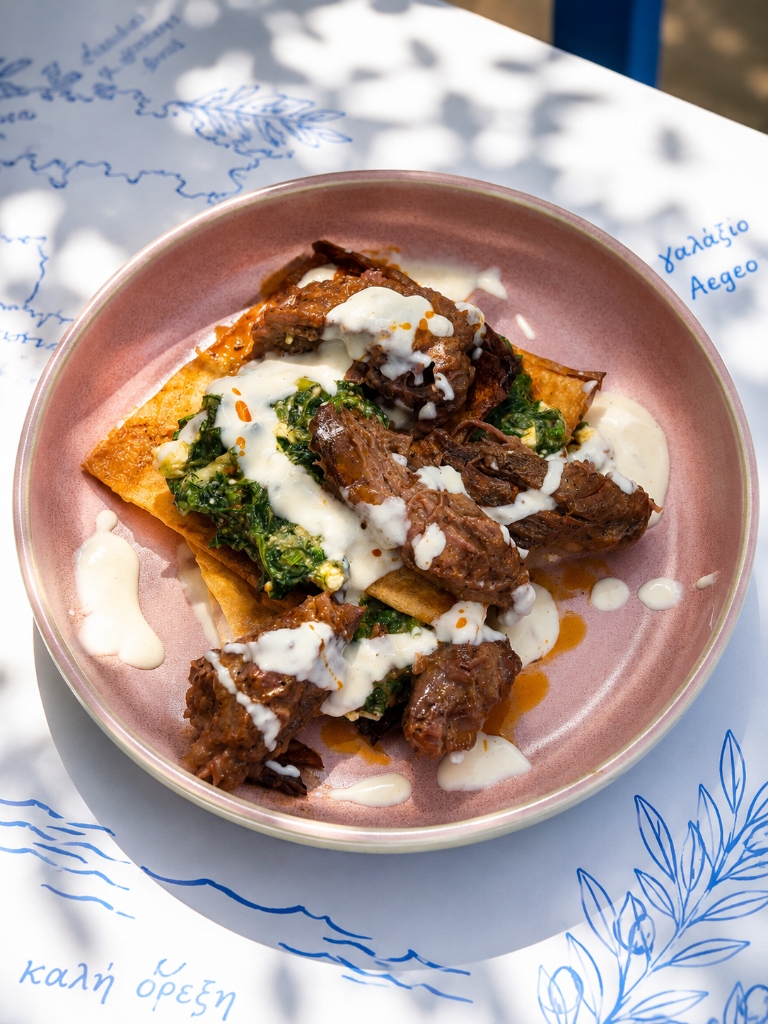

MOSHARI ME PITA
A LESSER-KNOWN STORY FROM GREEK CUISINE
When we talk about Greek cuisine, the first associations are usually gyros, souvlaki, moussaka, tzatziki, and Greek salad. These are the dishes that have long transcended the borders of Greece and become recognizable all over the world.
But behind them lies a much broader culinary tradition.
It lives in small towns, island settlements, and family kitchens. In recipes that rarely make it to tourist menus. In the way the same pita is prepared differently in Epirus, Thessaly, Macedonia, Kefalonia, or Crete. In the dishes whose exact proportions are remembered by Greek mothers and grandmothers without necessarily being written in a cookbook.
It is to this side of Greek gastronomy that we direct our attention with the new culinary weeks at Aristo Restaurant.
The new culinary weeks at Aristo Restaurant
The culinary weeks at Aristo are dedicated to traditional and lesser-known Greek dishes that the Bulgarian public rarely has the opportunity to try.
Our goal is to go beyond the most popular offerings and gradually present recipes, techniques, and flavor combinations from different parts of Greece.
These are dishes inspired by:
- family Greek cuisine;
- regional culinary traditions;
- seasonal products;
- old methods for slow-cooking meat;
- the variety of Greek pitas and phyllo dough;
- combining a simple product with careful culinary technique.
Every culinary week will be a new chapter of this story. We won't just repeat familiar recipes, but we will seek those flavors that reveal the deeper and less commercial side of Greece.
The first dish we begin with is "Moshari me pita".
What does "Moshari me pita" mean?
The name comes from the Greek phrase:
Μοσχάρι με πίτα - Moschári me píta
The literal translation is "beef with pita".
The word "μοσχάρι" (moshari) is used for young cattle and its meat. In a culinary context, it translates to beef or veal depending on the cut used. The meaning of the word can be verified in the Dictionary of Modern Greek of the Centre for the Greek Language.
It is important to make a clarification. "Moshari me pita" is not the name of a universally accepted national recipe with entirely fixed ingredients and a proven origin. The name is descriptive and can be used for various combinations of beef and pita.
In different restaurants and home kitchens, it can mean:
- slow-cooked beef served on a pita;
- beef served in flat Greek bread;
- beef gyros in pita;
- meat filling between phyllo layers;
- baked pita or pie with beef;
- an author's restaurant interpretation of beef with a crispy base.
Therefore, the version at Aristo Restaurant should be considered our culinary interpretation, inspired by the Greek tradition of meat dishes and pitas.
Pita as part of Greek culinary culture
The word "pita" in Greece has a broader meaning than the flatbread known to us.
It can denote both a round pita for gyros and souvlaki, and a baked dish with homemade rolled phyllo and various fillings. Greek pitas can be prepared with cheese, spinach, leeks, vegetables, meat, fish, rice, pasta, pumpkin, or wild greens.
According to the official tourism portal of Greece, one of the main characteristics of traditional Greek pitas is the phyllo (dough layers). They can be thick and crumbly, thin and almost transparent, or stacked in many layers.
There is no single universal Greek pita. The shape, filling, and baking method vary according to the region, local products, and family habits.
In Epirus, pitas with wild greens and cornmeal are common. In Thessaly, variations with leeks, cheese, and pumpkin are popular. The islands have their own pitas with fish, meat, artichokes, onions, or rice. It is this regional diversity that makes pitas one of the most interesting parts of Greek cuisine.
Meat in traditional Greek pitas
Beef and other types of meat also find their place in this tradition.
One of the most famous regional examples is the Kefalonian kreatopita - a meat pie from the island of Kefalonia. According to the official recipe by Visit Greece, its filling can include beef, pork, and goat meat, rice, tomato paste, red wine, onions, garlic, cheese, and herbs. Everything is enclosed between two homemade phyllo layers and baked to a golden color.
This example shows how naturally meat and dough bases coexist in Greek regional cuisine.
The Kefalonian kreatopita, however, is not the same dish as the version of "Moshari me pita" at Aristo Restaurant. It is a separate regional recipe that we use merely as an example of the rich Greek tradition of meat pitas.
What does Aristo's interpretation look like?
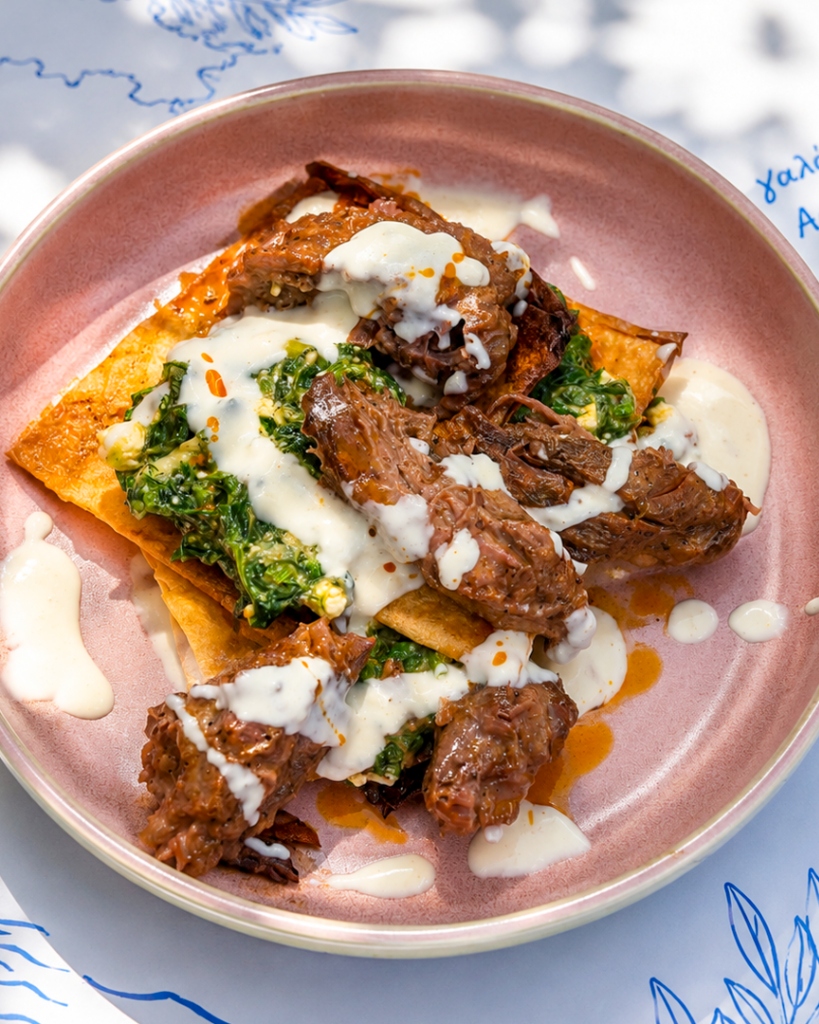
At Aristo Restaurant, we present "Moshari me pita" as a composition of slow-cooked beef, a crispy golden base, an aromatic sauce, and fresh green accents.
The dish is built around several important contrasts:
- tender beef and crispy pita;
- rich meat sauce and light fresh additions;
- warm aromas and delicate creaminess;
- a traditional culinary idea and modern restaurant presentation.
The main hero is the beef. Prolonged thermal processing allows the meat to gradually soften and absorb the aromas of the sauce. Instead of the individual components simply being placed next to each other, they are combined so that every bite brings a different texture.
The crispy base adds contrast to the juiciness of the meat. The sauce connects the flavors, and the green elements bring freshness and complete the composition. The result is a dish with an intense flavor, clear structure, and a recognizable Mediterranean profile.
Why is slow cooking important?
Different parts of beef require a different approach. Cuts with more connective tissue develop their best qualities through prolonged cooking at a moderate temperature.
In this process:
- the meat gradually softens;
- the collagen transforms and adds thickness to the sauce;
- the aromas of the meat, vegetables, spices, and liquid blend together;
- the sauce reduces and becomes more concentrated;
- each piece retains juiciness without remaining tough.
This is not just a longer way of cooking. It is a technique that transforms the appropriate beef cut into a tender and aromatic dish. With "Moshari me pita", it is precisely the softness of the beef that creates the main contrast with the crispy pita.
The taste of home Greek cuisine
When we talk about recipes kept by Greek mothers and grandmothers, we don't claim that every dish has a single ancient recipe that has remained unchanged through the centuries.
Home cooking evolves differently.
A recipe passes from family to family and gradually changes. One person adds more herbs. Another uses the meat available for the season. A third replaces one type of cheese with another local product. In one village the dish is baked between phyllo layers, and in another, the meat is served on a pita.
It is exactly these small differences that create the richness of regional Greek cuisine. The old Greek spirit is not contained only in the ingredient list. It is in the preparation method, in the shared table, in seasonality, and in the desire to create a wholesome dish from a few good products.
With Aristo's new culinary weeks, we want to present exactly this world - not as a museum reenactment, but as a living cuisine that continues to evolve.
A different encounter with Greece
"Moshari me pita" does not rely on the instant recognizability of gyros or moussaka. It attracts with something else - with the opportunity for the guest to try an unfamiliar combination and discover another layer of Greek gastronomy.
The dish is suitable for people who:
- love tender and juicy beef;
- seek less common Greek specialties;
- want to try something outside the standard restaurant menu;
- appreciate the contrast between crispy and juicy textures;
- show interest in the regional and family cuisine of Greece.
This is also the point of the culinary weeks - for every new offering to be not just a dinner, but an opportunity to discover a different recipe, region, or culinary story.
Greek cuisine in Aristo's garden
The experience at Aristo continues beyond the dish itself.
The restaurant is located in the Reduta neighborhood of the capital and features a spacious garden and a panoramic view of Sofia. The place combines a relaxed atmosphere, Greek cuisine, and space for lunch, dinner, or meeting with friends.
In the garden, the taste of "Moshari me pita" finds its natural setting - open space, greenery, and a view of the city. And for guests who arrive by car, the restaurant also offers free parking.
What comes after "Moshari me pita"?
"Moshari me pita" is the beginning of a series of culinary encounters with lesser-known Greece.
In the coming weeks, the menu will continue to reveal dishes inspired by regional recipes, family traditions, and characteristic Greek products. Every offering will have its own history and a different flavor profile.
Since the dishes are part of special culinary weeks, we recommend contacting the restaurant for current information regarding availability and the period they are offered.
FREQUENTLY ASKED QUESTIONS
What does "Moshari me pita" mean?
The name "Μοσχάρι με πίτα" literally means "beef with pita".
Is it a traditional Greek dish?
The combination of meat and pita has a deep place in Greek regional cuisine. However, the name itself doesn't denote a universal recipe with fixed ingredients. At Aristo Restaurant, the dish is an author's interpretation inspired by traditional Greek techniques and flavors.
How is it served at Aristo?
Aristo's version combines slow-cooked beef, a crispy base, an aromatic sauce, and fresh green accents.
Is it suitable for people with food allergies?
Pita usually contains gluten, and some additions may contain dairy or other allergens. Precise information depends on the recipe used. In case of allergy or intolerance, be sure to ask the restaurant staff before ordering.
Is it a permanent part of the menu?
The dish is presented as part of Aristo's special culinary weeks. For current availability and a specific period, contact the restaurant.
Taste a lesser-known side of Greek cuisine
Sometimes the most interesting culinary discoveries start beyond the most popular dishes.
With "Moshari me pita", Aristo Restaurant opens the first page of a new series dedicated to flavors that rarely reach Bulgarian restaurant menus.
Slow-cooked beef, a crispy pita, a rich sauce, and a different encounter with Greece await you - in Aristo's garden with a panoramic view of Sofia.
📍 37 Velcho Atanasov St., Reduta, Sofia
📞 +359 883 77 50 77
🚗 Free parking for our guests.
EXPLORE OUR MENU MAKE A RESERVATIONAddress
гр. Sofia, България
ж.к. Редута, ул. Велчо Атанасов №37
Opening Hours:
Понеделник - Петък
12.00 ч. - 23.30 ч.
Събота - Неделя
12.00 ч. - 23:00 ч.
(Кухнята приема поръчки до 22:30 ч.)
Phone & Email
Phone: +359 883 77 50 77
office@aristosofia.bg